Research · Work in progress
The Science of Taste.
Abstract
The purpose of this research is to lay out a scientific basis for a rigorous approach to sensory lexicon, instead of the previously used intuitive approach.
Taste, flavour, smell and aftertaste
Taste
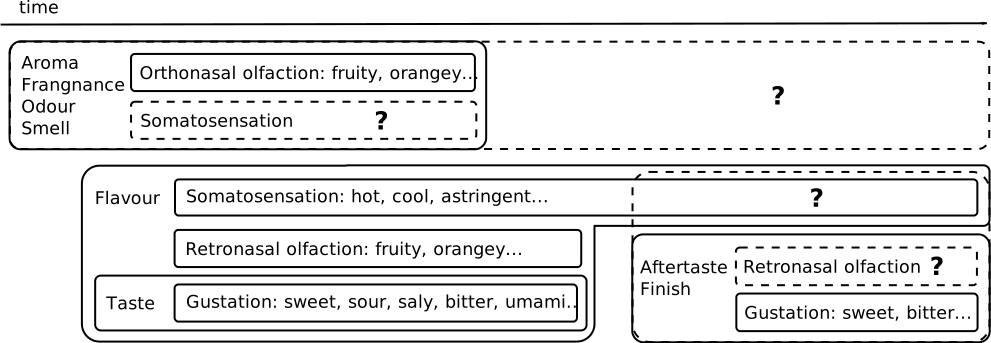
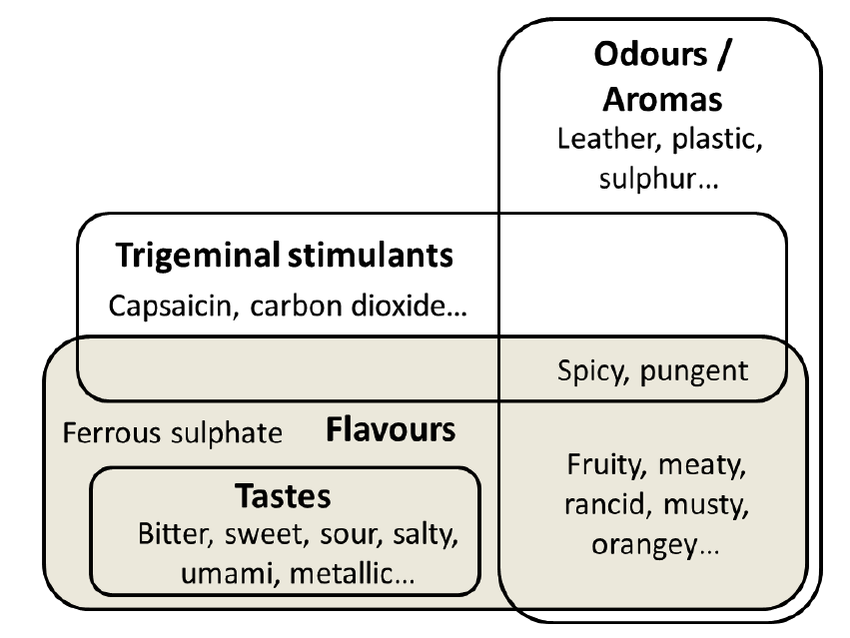
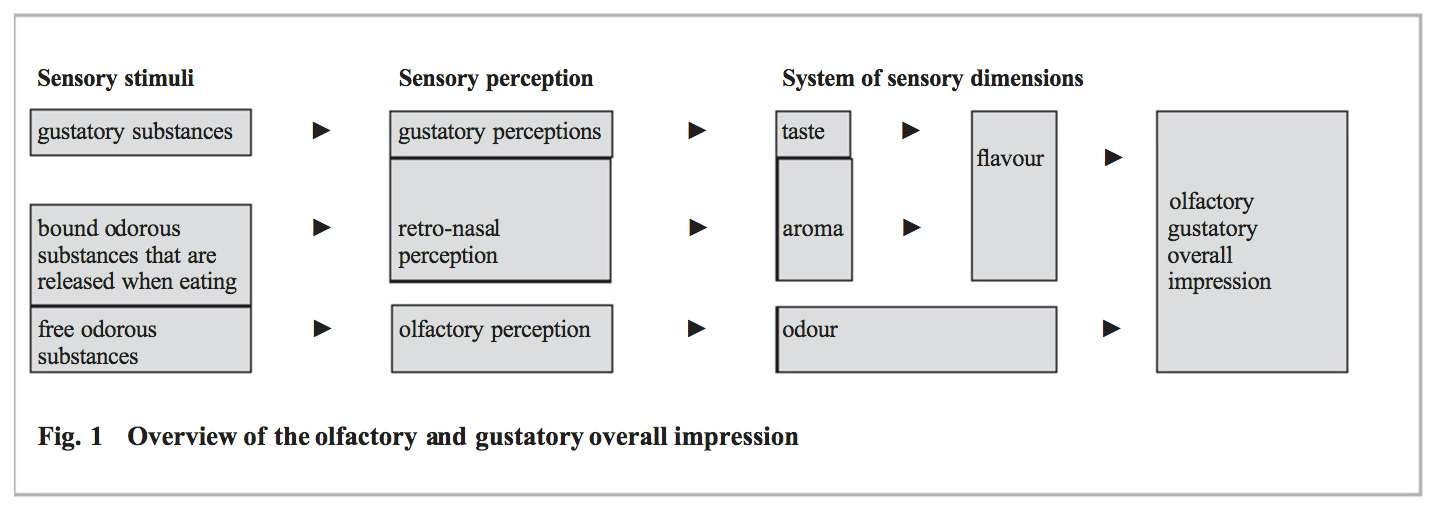
In common language, the word "taste" is often used to describe sensations arising from the oral cavity. The biological definition of taste, or gustation, is narrower: it includes only sensations mediated by a specialised anatomically- and physiologically-defined chemosensory gustatory system. Along with taste sensations, food usually simultaneously evokes other sensations — odour, touch, temperature, irritation. Although these aren't always easy to separate perceptually, the non-gustatory components are sensed by different systems: olfaction and somatosensation.
Flavour
A complex combination of olfactory, gustatory, and trigeminal [ed. note: somatosensation] sensations perceived during tasting. Flavour may be influenced by tactile, thermal, painful, and kinaesthetic effects.
Orthonasal vs. retronasal olfaction
Odours often produce different sensations when presented in front of the nose vs. intraorally, when eaten. It is a long-standing question whether these differences are due, for example, to additional mechanical sensations elicited by food in the mouth or to additional odour release during mastication. The differences between ortho- and retronasal perception are thought to be, at least partly, due to absorption of odours to the olfactory epithelium, which appears to differ in relation to the direction of airflow across that epithelium.
Aftertaste
Aftertaste is the taste intensity of a food or beverage perceived immediately after it is removed from the mouth. Aftertastes vary by intensity and over time, but the unifying feature is that they are perceived after a food or beverage is swallowed or spat out. The neurobiological mechanisms of taste — and aftertaste — signal transduction from receptors in the mouth to the brain have not yet been fully understood.
Types of sensations and receptors
The first part of the table below is taken from "The receptors and cells for mammalian taste" (2006).
| Tastant | Receptor(s) | Class | Examples |
|---|---|---|---|
| Umami | T1R1 + T1R3 | Amino acids | L-glutamate, L-AP4, glycine, L-amino acids |
| Nucleotide enhancers | IMP, GMP, AMP | ||
| Sweet | T1R2 + T1R3 | Sugars | Sucrose, fructose, glucose, maltose |
| Artificial sweeteners | Saccharin, acesulfame-K, cyclamate, aspartame | ||
| D-amino acids | D-phenylalanine, D-alanine, D-serine (also some selective L-amino acids) | ||
| Sweet proteins | Monellin, thaumatin, curculin | ||
| More: SuperSweet. | |||
| Bitter | T2R5 | Cycloheximide | |
| T2R8, T2R4, T2R44 | Denatonium | ||
| T2R16 | Salicin | ||
| T2R38 | PTC | ||
| T2R43, T2R44 | Saccharin | ||
| More: BitterDB, BitterDB paper (2011). | |||
| Sour | PKD2L1 | Acids | Citric, tartaric, acetic, hydrochloric acid |
| More: "The candidate sour taste receptor PKD2L1" (2007), "The chemistry and physiology of sour taste — a review" (2007). | |||
| Recent research, still in progress | |||
| Calcium | CaSR | "T1R3: A human calcium taste receptor" (2012) | |
| Fattiness | CD36 | Long-chain fatty acids | "Reversible binding of long-chain fatty acids to purified FAT, the adipose CD36 homolog" (1996) |
| GPR120 & GPR40 | Fatty acids | Linoleic and oleic acid. "Taste preference for fatty acids is mediated by GPR40 and GPR120" (2010) | |
| Heartiness (kokumi) | Glutathione. Hettiarachchy et al. (eds.), Food proteins and peptides (CRC, 2010). | ||
| Carbonation | "The Taste of Carbonation" (2009) | ||
| Starchiness | Glucose oligomers | "Humans can taste glucose oligomers independent of the hT1R2/hT1R3 sweet taste receptor" (2016) | |
| Alkaline | "The Alkaline Taste" (1956) | ||
| Metallicness | TODO: find research. | ||
| Somatosensory system | |||
| Hotness | TRPV1, TRPA1 | Ethanol, capsaicin, piperine. TODO: find research. | |
| Coolness | TRPM8 ion channels | Spearmint, menthol, ethanol, camphor. TODO: find research. | |
| Numbness | Sichuan pepper. "Challenges in taste research" (2003) | ||
| Astringency | "Astringency: A More Stringent Definition" (2014), "Astringency: Mechanisms and Perception" (2008) | ||
| Texture | TODO: find research. | ||
| Temperature | TODO: find research. | ||
| Olfactory system | |||
| Everything else we sense is supposed to fall under this category. Online databases for aromas: MetaChemiBio, flavornet, SuperScent, FooDB, Zinc. | |||
| Aftertaste | |||
| A taste sensation still to be researched. TODO: find research. | |||
Prominent research on taste science
Challenges in taste research: present knowledge and future implications (2003)
A brief survey on the chemistry of gustatory taste sensations — the perception of sour, sweet, salty, bitter, umami — and lingual somatosensory sensitivity from temperature, tactile stimulation, and chemical activation of chemosensory receptors. Presents present challenges in taste chemistry and biochemistry and discusses future perspectives.
A study of the science of taste: on the origins and influence of the core ideas (2008)
Our understanding of the sense of taste is largely based on research designed and interpreted in terms of the traditional four "basic" tastes — sweet, sour, salty, bitter — and now a few more. The concept of basic tastes has no rational definition to test, and thus it has not been tested. As a demonstration, a preliminary attempt at testing one common but arbitrary psychophysical definition of basic tastes is included: that the basic tastes are unique in being able to account for other tastes. This definition was falsified: other stimuli do about as well as the basic ones. The validity of the century-long literature based on a few "basics" is called into question. The article discusses the possible origins, meaning, and influence of the concept, and proposes the across-fiber pattern model as a stronger alternative.
The science of taste (2014)
An understanding of sensory perception of food requires input from many disciplines. For the natural sciences the key concept is flavour, encompassing physical, chemical, and neurophysiological aspects. For human sciences, psychology, anthropology, and social sciences, taste is a broader concept related to tradition, geography, culture, and social relations. For cooks and practitioners, taste is a multimodal facet of food and the way we perceive and enjoy it.
Confusing tastes with flavours (2015)
The use of the terms "taste" and "flavour" is often confusing, both in everyday speech and in the academic literature. Failure to distinguish these basic terms slows the development of our understanding of the chemical senses. The paper defends the view that experiences of putative basic tastes — "sweetness", "sourness" — in everyday experience should be treated not as tastes but as flavours, just like "fruity" or "meaty".
History of sensory lexicon development
First flavour wheel: beer
The beer flavour wheel was developed in the 1970s by Morten Meilgaard. It was subsequently adopted as the flavour analysis standard by the European Brewery Convention, the American Society of Brewing Chemists, and the Master Brewers Association of the Americas.
In 2009 A. Schmelzle produced an updated version of the beer flavour wheel.
Wine Aroma Wheel
In 1984 Ann C. Noble invented the Aroma Wheel for wine tasting terminology.
Coffee flavour wheel
In 1995 SCAA created the coffee flavour wheel. What coffee professionals may not know is that the wheel was created as a visual tool to accompany The Coffee Cupper's Handbook: each term was very purposefully placed to represent the weight of the molecules it was meant to represent.
In 2013 Counter Culture Coffee made its own version of the coffee flavour wheel.
In 2016 SCAA and WCR produced an updated version of the coffee flavour wheel. See our interactive flavor wheel.
Cheese flavour wheel
Since 1996 Mary Ann Drake PhD has directed the North Carolina State University Sensory Service Center, which specialises in sensory evaluation of dairy products. She and her colleagues produced the cheese flavour wheel, as well as a more specific cheddar cheese lexicon.
Comparison and further development of sensory lexicons
Flavor Lexicons (2003)
Flavour lexicons are a widely-used tool for documenting and describing sensory perception of a selected food. Development of a representative lexicon requires several steps: appropriate product frame-of-reference collection, language generation, and designation of definitions and references before a final descriptor list can be determined. Once developed, lexicons are used to record and define product flavour, compare products, determine storage stability, and interface with consumer liking data.
A System for Classifying Sensory Attributes
Data from a descriptive analysis panel sometimes fails to detect differences between products for one or more sensory attributes. Results might nonetheless be consistent with the best possible data; lack of discrimination can be meaningful information if no true sensory difference exists between products for the attribute — for instance, when all products fall within one just-noticeable-difference (JND) interval. A panel leader sometimes has prior knowledge of a product group and what level of performance is possible for particular sensory attributes within the product context. Systematic classification of sensory attributes — based on the difficulty associated with identifying and scaling the attribute in specific product contexts — can make this information available to the broader community of sensory practitioners.
Other reading
- The drinking water taste and odor wheel for the millennium: beyond geosmin and 2-methylisoborneol (1999)
- More fizz for your buck: high-impact aroma chemicals (2000)
- High-impact aroma chemicals II: the good, the bad, and the ugly
- Origins of flavour in whiskies and a revised flavour wheel: review (2000)
- A brandy aroma wheel for South African brandy (2000)
- Creating and validating an aroma and flavor lexicon for the evaluation of sparkling wines (2003)
- Sensory analysis applied to honey: state of the art (2004)
- The anatomy of odour wheels for odours of drinking water, wastewater, compost and the urban environment (2007)
- The chemistry of beef flavor (2007)
- Development of a lexicon for beef flavor in intact muscle
- Flavor formation and character in cocoa and chocolate: a critical review (2008)
- Aroma chemicals II: heterocycles (2009)
- Aroma characterisation of American rye whiskey by chemical and sensory assays (2010)
- Sensory assessment scoresheets for fish and shellfish (2010)
- The significance of volatile sulphur compounds in food flavours (2011)
- Character impact compounds: flavours and off-flavours in foods (2013)
- Flavour chemistry of cocoa and cocoa products — an overview (2015)